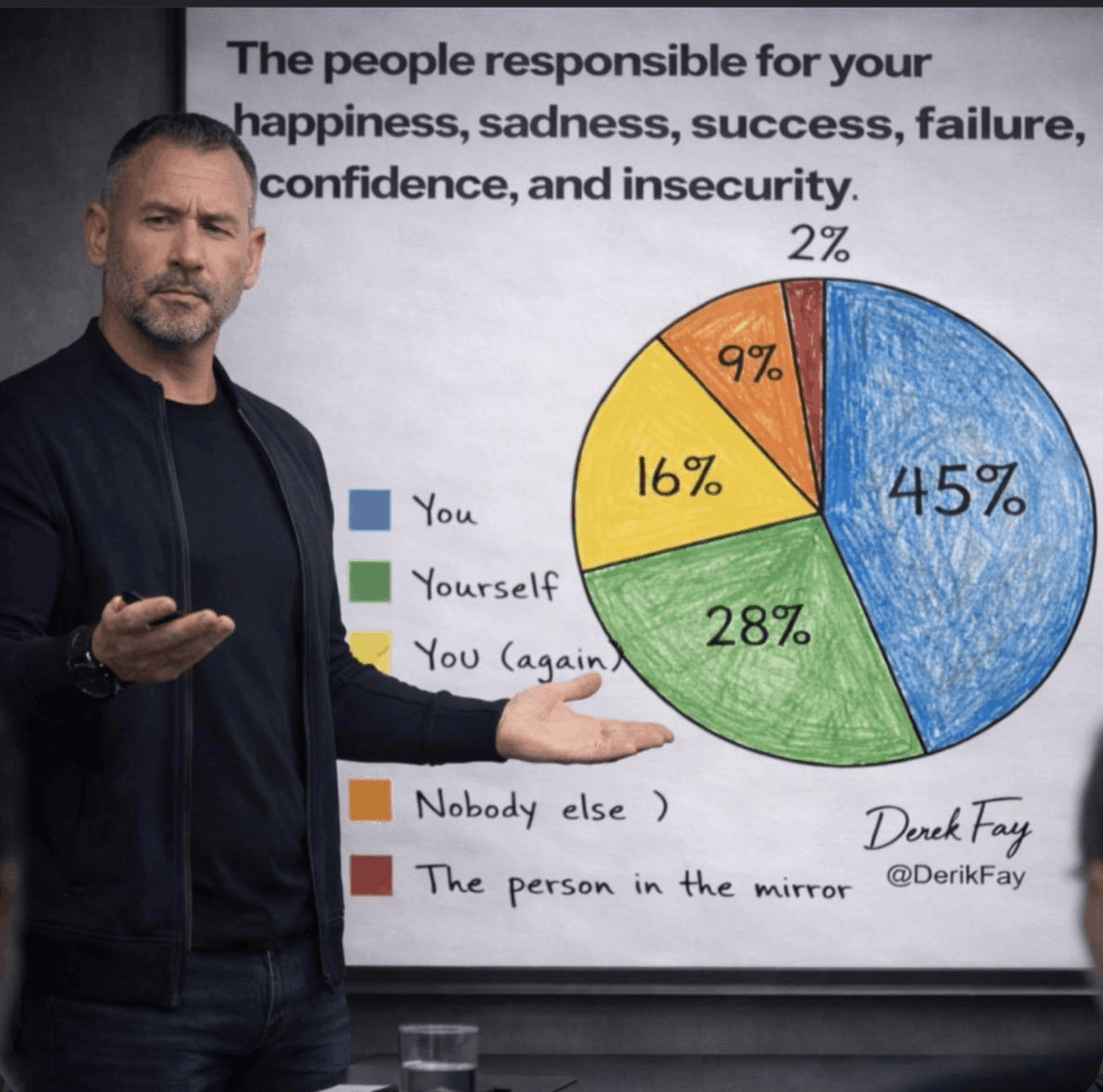
In a culture where blame travels faster than accountability, Derik Fay just delivered a message most people would rather scroll past.
Standing in front of a pie chart labeled “The people responsible for your happiness, sadness, success, failure, confidence, and insecurity,” Fay makes the point unmistakable. Nearly every segment of the chart points back to one source: you.
The visual is almost humorous at first glance. “You.” “Yourself.” “You (again).” “The person in the mirror.” “Nobody else.” But beneath the simplicity is a principle that defines high performers across industries:
Nothing outside of you is running your life.
It only feels that way because ownership is uncomfortable.
The Psychology of Blame
Fay’s caption cuts directly to the pattern many people live in:
“The chaos, the setbacks, the doubt, the wins, the confidence, the insecurity — all of it is filtered through your choices, your discipline, and your focus.”
That framing removes the safety net of external excuses. It challenges the habit of blaming circumstances, competitors, family dynamics, timing, or luck.
Blaming circumstances is easy.
Blaming people is lazy.
Ownership, however, requires self-audit.
And self-audit is where growth begins.
The Power of Being the Common Denominator
One of the most striking lines in the post reads:
“Progress starts the moment you stop negotiating with reality and accept that you are the common denominator in every outcome you keep repeating.”
That statement flips the narrative most people tell themselves. If outcomes are repeating — financial patterns, relationship patterns, career ceilings — the instinct is to look outward.
Fay suggests looking inward.
Because once you recognize yourself as the constant variable in every scenario, something shifts. You stop waiting for environments to change. You stop needing validation to act. You stop hoping someone else adjusts first.
You start adjusting.
Radical Responsibility as Competitive Advantage
From a business perspective, this mindset is lethal in the best way.
Leaders who accept full responsibility adapt faster. They don’t waste energy defending ego. They don’t linger in resentment. They recalibrate and move.
In a marketplace driven by speed and uncertainty, the ability to self-correct quickly becomes a strategic advantage.
If the problem is always external, improvement is impossible.
If the problem might be internal, growth becomes accessible.
That is the edge.
Freedom Through Ownership
Ironically, the message is not heavy — it’s liberating.
Once you accept that you are the primary driver of your outcomes, nothing outside of you has the same power to derail you. External pressure becomes data instead of defeat.
When you stop negotiating with reality, you stop arguing with what is — and start building what could be.
The pie chart may look simple. But the implication is profound:
You are responsible.
Which means you are powerful.
And once you truly own that, everything changes.